Screenwriting Best Practices
Most screenplays don’t fail because the idea is bad. They fail because the execution gets in the way of the story.
When someone is reading a script, whether it’s an actor, producer, or executive, anything that pulls them out of the narrative works against you. A lot of that friction comes from small, technical choices that feel minor but add up fast.
I’ve heard that most executives want to see more white on every page because the more ink there is, the more expensive the budget is going to be. Yet I also hear that actors immediately look for their lines, trying to find the coveted award winning monologue that spans two pages.
Here are a few screenwriting best practices I’ve learned over the years that help keep the focus where it belongs: on the story.
Parenthetical’s: Use Them Like Salt
The way you us parenthetical’s are the quickest way to reveal your maturity of a writer. .
They aren’t inherently bad, but they are often overused. Most of the time, they’re doing the job that the dialogue or action should already be doing. No one likes micro-directing. If you are writing a script that you will be directing, than you can be a little more fast and loose with this. But if you are writing a script to be produced and directed by someone else, they won’t need your directing input.
If you find yourself stacking parenthetical’s, you’re probably trying to control the performance too tightly.
Instead of telling an actor how to say something, ask yourself if the line itself is doing enough work. When a parenthetical is necessary, it should clarify intention, not dictate delivery.
If the emotion is obvious, cut it. Trust that the actor will bring their performance from an authentic place.
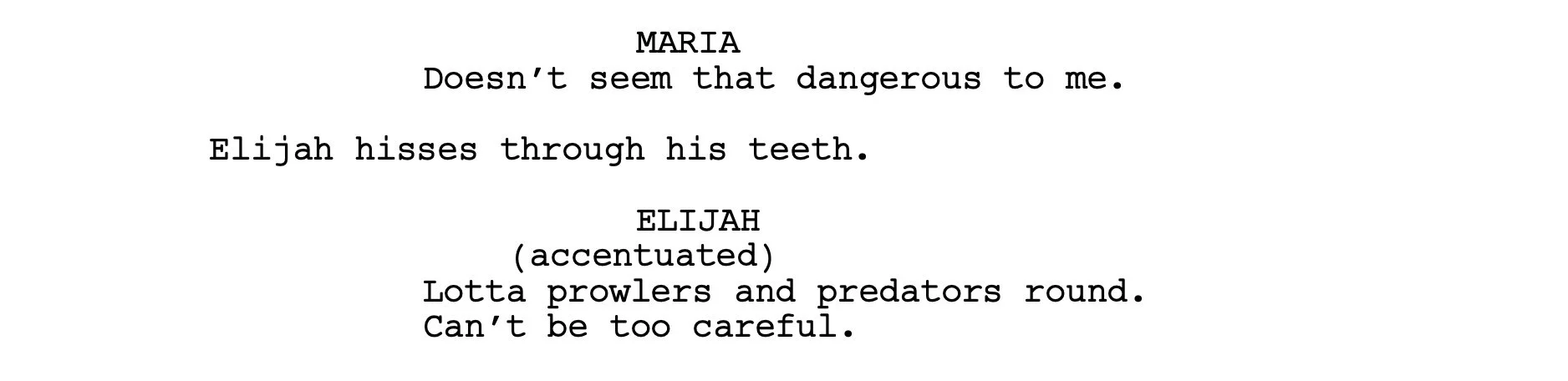
Let your actor discover the way they will perform the line.
Widow and Orphan Words: Formatting Matters
Widow and orphan words usually show up unintentionally, single words stranded at the top or bottom of a page due to formatting.
While they might seem harmless, they interrupt the visual flow of the script and can pull a reader out of the experience. In professional reads, they often come across as sloppy rather than stylistic.
I’ll be honest. I just learned about this. I have been writing for 15+ years and never thought about this. I am currently developing a feature, and in final revisions for the script, and just did a pass removing orphan words. Not only did it force me to tighten up action lines, it cut 3 PAGES out of the script.
This doesn’t mean you can never isolate a word. It means you should only do it on purpose.
If a single word is standing alone, ask yourself:
Is this intentional emphasis?
Or did the formatting do this accidentally?
If it’s accidental, fix it. Tighter writing is confident writing.
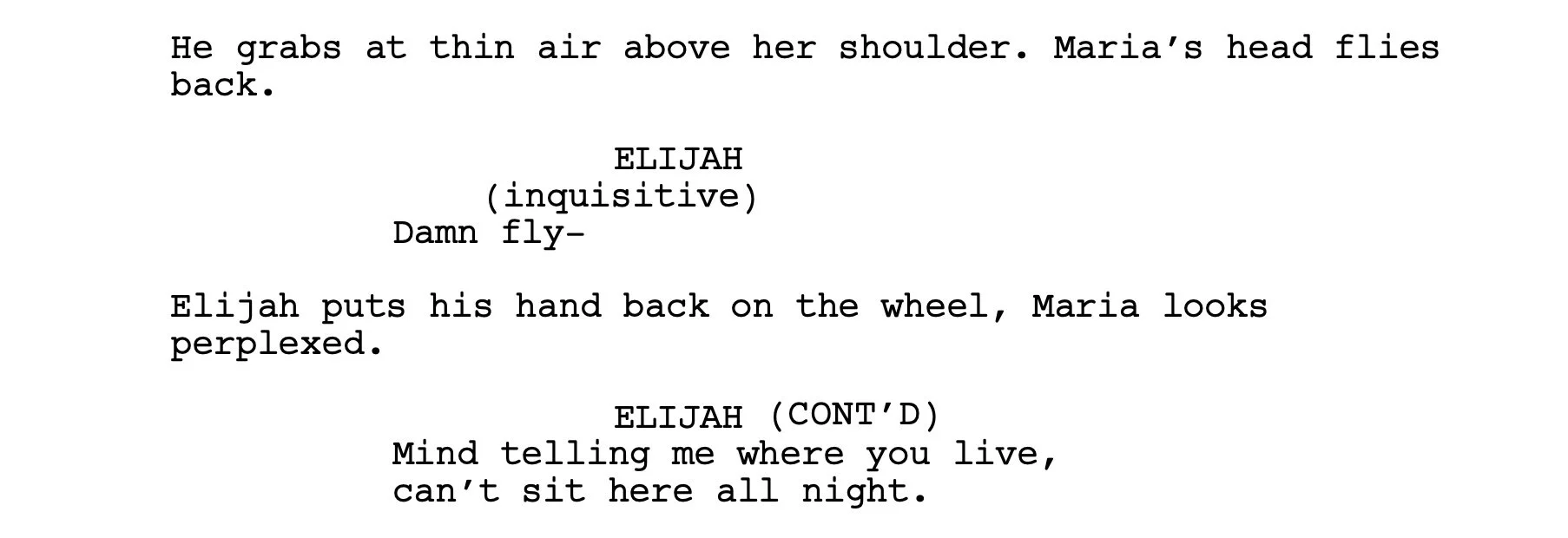
Orphan words tend to happen in your first draft.
Show, Don’t Tell (The Hardest Rule to Follow)
This is the rule everyone knows and still struggles with.
“Show, don’t tell” doesn’t mean avoiding dialogue. It means avoiding explanation. If a character has to explain how they feel, chances are the scene hasn’t earned it yet.
My first garbage draft a lot of my dialogue is exposition heavy. When I begin the rewrite the process, I go through it scene by scene, examining each line. I challenge myself, to discover ways to say the line, or inform the audience without actually saying it.
Look for moments where behavior can replace dialogue:
A choice instead of a confession
An action instead of a monologue
A reaction instead of an explanation
Subtext is where story lives. If everything is said out loud, there’s nothing for the audience to discover.
Final Thought
Great screenwriting isn’t about showing off how well you write. It’s about disappearing behind the story.
The best scripts feel effortless to read, not because they were easy to write, but because every choice was intentional.
When in doubt, simplify. When tempted to explain, cut. And when the page gets noisy, remember: the goal is momentum, not perfection.